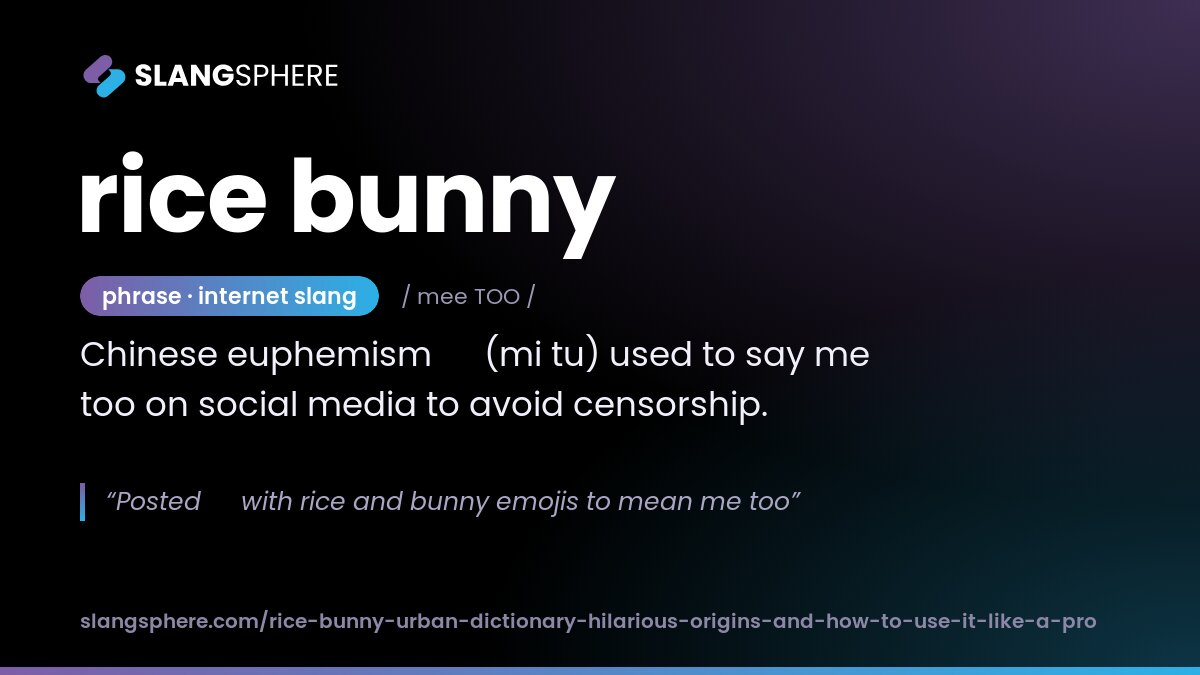
Rice bunny is a coded phrase from Chinese 米兔 (mi tu) that Chinese netizens used as a visual and phonetic way to say “me too” to avoid social media censorship. It shows up as the characters 米兔 or rice and rabbit emojis and also has unrelated, rarer uses in English slang. ([en.wikipedia.org](https://en.wikipedia.org/wiki/MeToo_movement_in_China?utm_source=openai))
What it means
Main meaning: In China, 米兔 pronounced mi tu, literally rice plus rabbit, became a substitute for the English phrase me too during the 2018 #MeToo moment. People used the characters and rice plus bunny emojis to report sexual harassment and show solidarity without triggering automated censorship. ([euronews.com](https://www.euronews.com/2018/05/03/chinese-feminists-push-metoo-movement-amid-censorship-n870081?utm_source=openai))
Secondary meanings: Outside that specific Chinese usage, you may see the words or the emoji combo used jokingly, as a username, or as a meme. There is also a user-submitted Urban Dictionary entry that defines rice bunny in a sexualized, racialized way, but that is a fringe Western usage and not the origin of the Chinese term. ([urbandictionary.com](https://www.urbandictionary.com/define.php?page=1&term=rice+bunny&utm_source=openai))
Where it comes from
The origin is linked to 2018, when the direct #MeToo hashtag encountered heavy moderation on Chinese platforms, so activists and bystanders adopted 米兔, pronounced mi tu, as a pun that sounds like “me too.” The rice and rabbit imagery made for a simple visual code that was harder to ban than the English hashtag. Researchers and media covered this as a deliberate workaround to censorship. ([freedomhouse.org](https://freedomhouse.org/sites/default/files/FH_CMB_2018_En_Oct_130.pdf?utm_source=openai))
For contemporary reporting and background see Euronews on the rice bunny workaround and the Wikipedia summary of MeToo in China. ([euronews.com](https://www.euronews.com/2018/05/03/chinese-feminists-push-metoo-movement-amid-censorship-n870081?utm_source=openai))
How people use it
- “Posted 米兔 and a rice bowl, felt less alone today.”, public solidarity, signaling a personal harassment story without naming names.
- “米🐰 #我也是”, compact post combining Chinese characters, emojis, and the phrase I am also to join a thread.
- “She changed her bio to 米兔 after the article dropped.”, profile signal that a user supports or has experienced MeToo disclosures.
- “lol my username is rice_bunny, not related to activism”, self-aware or joking username use that is separate from the political meaning.
- “Someone called her a rice bunny in the forum, sounded racist and gross.”, shows how the phrase can be misused in English contexts with sexualized or fetishizing connotations. ([urbandictionary.com](https://www.urbandictionary.com/define.php?page=1&term=rice+bunny&utm_source=openai))
Tone and when not to use it
Because 米兔 started as a coded way to report and support survivors of harassment, use it carefully. In a Chinese context, it is typically political and serious, not a joke. Avoid using the phrase to fetishize people, or in contexts that reduce a disclosure to a meme. In English chats, be cautious: some Western uses are sexualized or racialized and can be offensive. When in doubt, do not use it in professional or sensitive conversations.
Similar terms
metoo, mi tu, 米兔, snow bunny, coded hashtag
FAQ
What does rice bunny mean on TikTok or Weibo? On Chinese platforms it usually means 米兔, the mi tu code for Me Too; on TikTok users may also use the words or emojis as a meme or username, so check context. ([en.wikipedia.org](https://en.wikipedia.org/wiki/MeToo_movement_in_China?utm_source=openai))
Is rice bunny rude or offensive? It depends. The Chinese usage is a solidarity symbol for harassment survivors. Some Western uses are derogatory or sexualized, so avoid using the phrase about someone’s race or sexual life. ([urbandictionary.com](https://www.urbandictionary.com/define.php?page=1&term=rice+bunny&utm_source=openai))
Did activists invent it? There is no single inventor listed. It emerged among Chinese netizens in 2018 as a grassroots workaround to moderation, and researchers documented the shift from #MeToo to 米兔. ([researchgate.net](https://www.researchgate.net/profile/Jing-Zeng-31/publication/338395390_MeToo_as_Connective_Action_A_Study_of_the_Anti-Sexual_Violence_and_Anti-Sexual_Harassment_Campaign_on_Chinese_Social_Media_in_2018/links/6086d2f4907dcf667bc6f25c/MeToo-as-Connective-Action-A-Study-of-the-Anti-Sexual-Violence-and-Anti-Sexual-Harassment-Campaign-on-Chinese-Social-Media-in-2018.pdf?origin=publication_detail&utm_source=openai))
Related Slang
- snow bunny