The term 86 means to throw out, refuse service to, cancel, or mark something as unavailable. It began as American hospitality slang for an item being out, then became a verb used for ejecting or getting rid of people or things. Below are verified origins, real examples, tone notes, and a short FAQ.
What it means
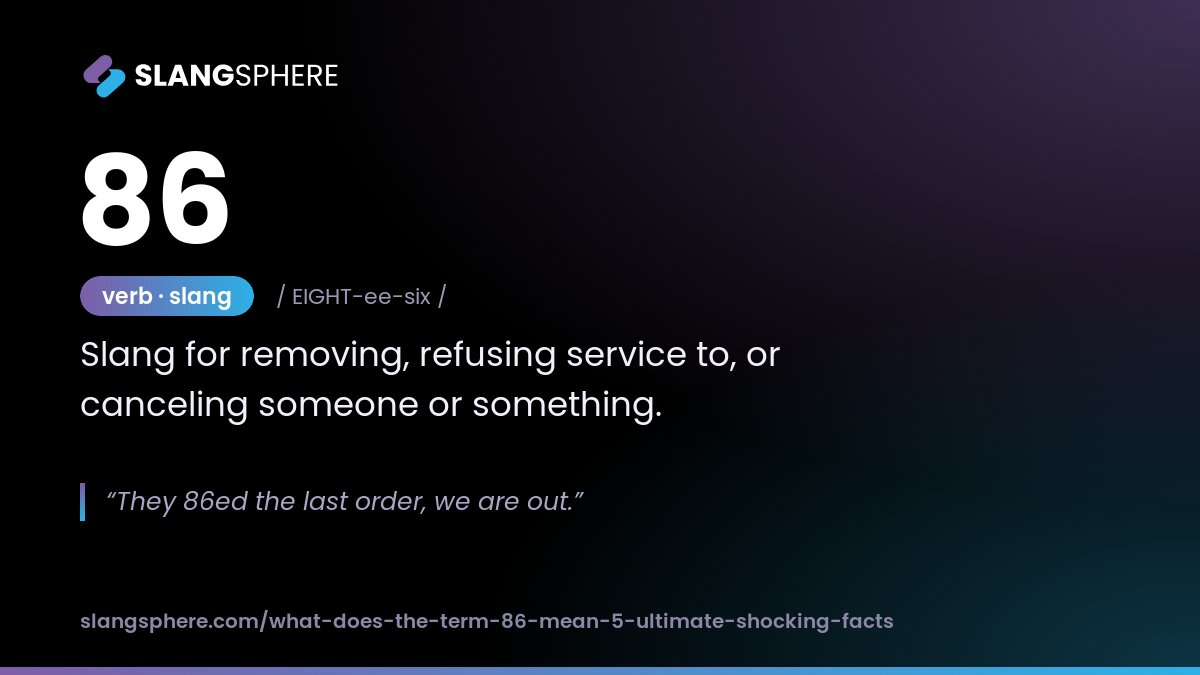
Main meaning: 86 generally means to remove, refuse, or get rid of something or someone. As a noun it can mean an item that is sold out or a person who is unwelcome. As a verb it can mean cancel, eject, or refuse service: “They 86ed the order,” “We 86ed him from the bar.”
Secondary uses: Some speakers use 86 more broadly for “scrap” or “cut” (for example, “86 the logo”). A rarer, more recent sense implying “kill” has appeared in some contexts, but major dictionaries treat that usage as limited and recent.
Where it comes from
The exact origin is unclear, but reliable lexicographers trace 86 back to American soda-fountain and lunch-counter slang in the early 1930s, where it meant an item was sold out. The most commonly cited explanation is that 86 was rhyming slang for “nix.” For summaries and early citations see Merriam-Webster and a concise historical overview at History.com. Other origin stories exist, including tales about Chumley’s at 86 Bedford Street and various military or municipal explanations, but none is definitively proven.
How people use it
- “86 the shrimp, we ran out.”, Straight kitchen instruction to stop taking orders for a menu item.
- “We had to 86 that table after they started a fight.”, Staff saying they ejected a problem customer.
- “Can we 86 the last slide from the deck?”, Office shorthand for remove or cut something.
- “He got 86ed from the club last night.”, Casual report that someone was banned or kicked out.
- “86ed the DM request, not interested.”, Social-media shorthand for rejecting or blocking someone.
Tone and when not to use it
86 is informal workplace and hospitality jargon that reads casual and a little insider. It is not inherently offensive, but context matters. Avoid using it where a literal threat could be implied, because some listeners may interpret aggressive or violent intent depending on surrounding language. Do not use it in formal communication that requires neutral phrasing, for example HR emails, legal notices, or customer-facing statements.
Similar terms
nix, kick out, boot, cancel, scrap, cut
FAQ
What does 86 mean on TikTok or social media? On TikTok it usually keeps the same meanings: reject, remove, or stop something. Creators use it casually in captions or comments to say they are done with an idea, person, or trend.
Is 86 rude or offensive? Not by itself. It is blunt and informal, so it can come off harsh if used toward a person. Prefer softer language in sensitive situations.
Where’s the earliest evidence for 86? Print citations date to the early 1930s in soda-fountain and lunch-counter slang, with the noun sense meaning an item was sold out and later shifting to verb uses. See Merriam-Webster for early examples.
Does 86 ever mean kill? Some recent uses imply extreme removal or even killing, but major dictionaries note that sense is recent and uncommon, so do not assume that meaning unless the context explicitly suggests violence.
Related Slang
- nix
- scrap