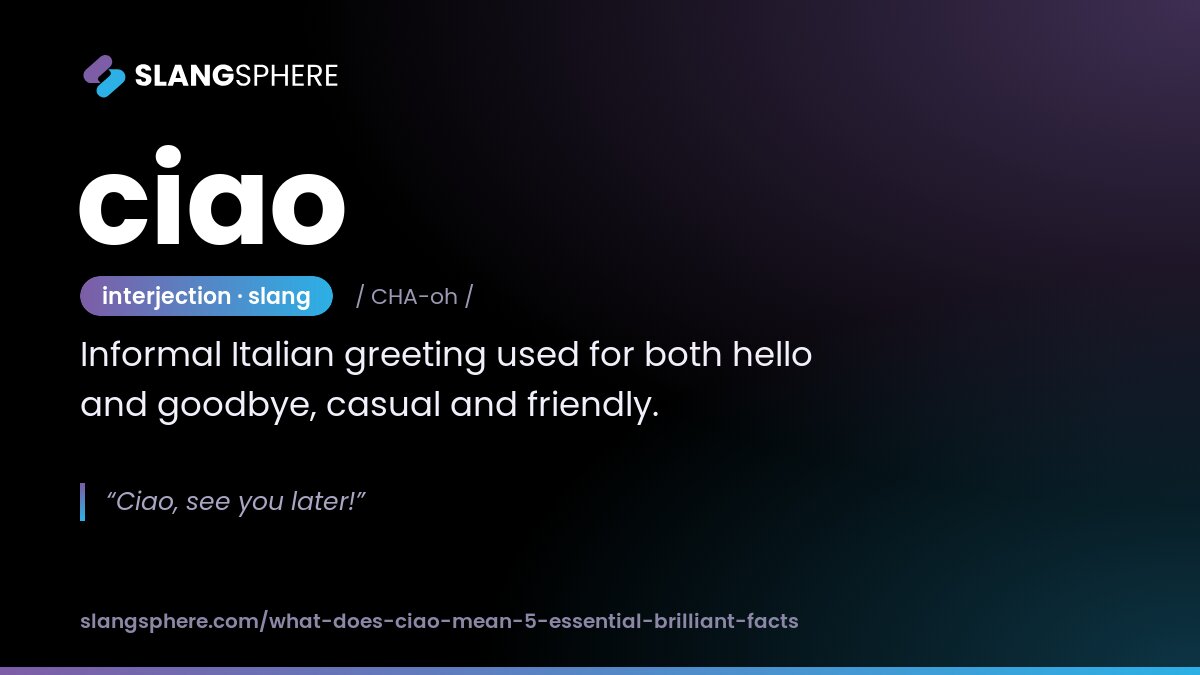
Ciao is an informal Italian greeting used for both hello and goodbye, casual and friendly in tone. It started as a polite formula in Venetian and now appears worldwide as a breezy way to greet or leave someone, often used among friends, captions, and informal speech.
What it means
Main meaning: a casual interjection for hello and goodbye, like hi or bye. Secondary meaning: in rare uses it can feel playful, stylish, or deliberately continental when used by non-Italians.
Where it comes from
The word traces back to Venetian s-ciao or s-ciavo, originally meaning “(I am) your slave” or “your servant,” a formula of deference that shortened and lost its literal force. Linguists connect that Venetian term to medieval Latin sclavus, which gave rise to Italian schiavo. For a concise etymology see Etymology Online and the modern dictionary note at the Cambridge Dictionary.
How people use it
- “Ciao! Long time no see.”, Friendly hello between acquaintances.
- “Thanks for coming, ciao!”, Casual goodbye at the end of a small gathering.
- “Posting selfie: ciao, Venice!”, Caption tone: playful and travel-flavored.
- “Ok, ciao everyone, I’m off to work.”, Informal workplace chat among close coworkers.
- “He texted ‘ciao’ after the date and ghosted.”, Can signal nonchalance depending on context.
Tone and when not to use it
Tone: informal, warm, slightly cosmopolitan when used in English. It is not appropriate in formal or professional contexts where Italian speakers would use buongiorno or arrivederci with strangers, elders, or business contacts. Avoid using it in highly formal emails, serious announcements, or when you need to sound neutral and polite.
Similar terms
hola, bonjour, arrivederci, salve, bye
FAQ
Is ciao only used to say goodbye? No. In Italian ciao is used for both hello and goodbye, though English speakers sometimes use it mainly as a goodbye.
Can I say ciao in a job interview or to an elder? No. In formal situations use buongiorno, buona sera, or arrivederci. Ciao is for friends and informal settings.
How do you pronounce ciao? In Italian it is two syllables, the stress on the first: CHA-oh, where the initial sound is like English ch in chair.
Is ciao rude or offensive? No. Its root referred to servitude historically, but modern usage is friendly and nonoffensive. Context matters: if used flippantly after a meaningful conversation, it can come off as dismissive, but that is about tone rather than the word itself.
Related Slang
- bye