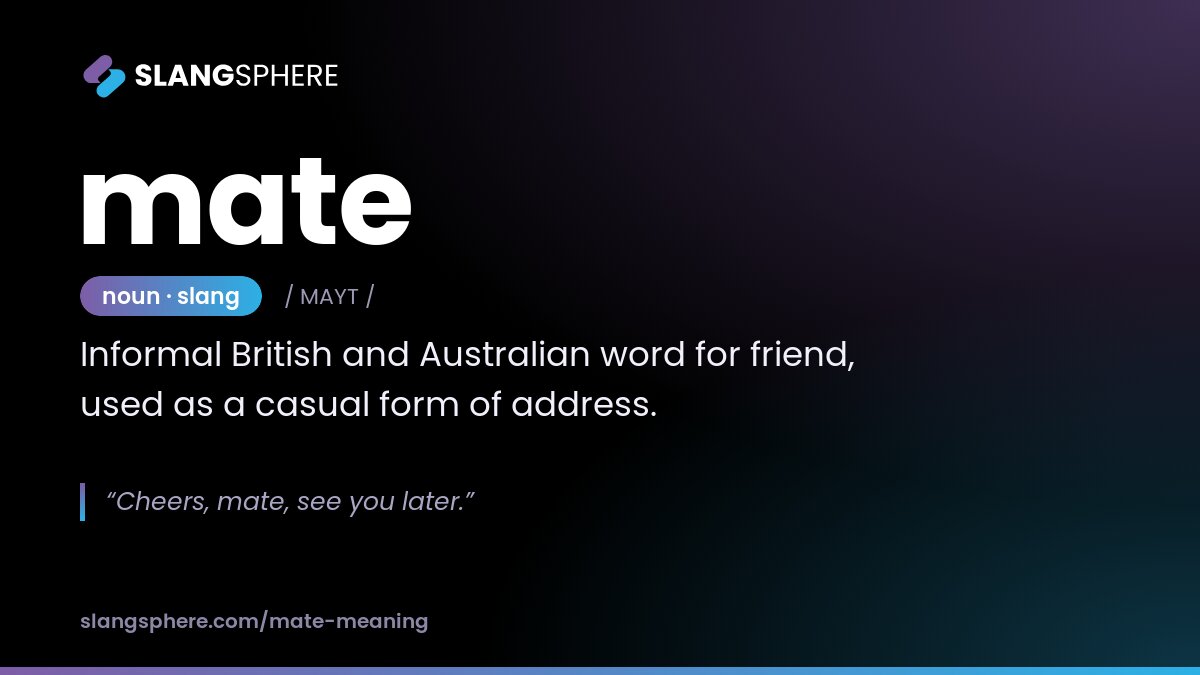
Mate is an informal British and Australian slang word that means friend or buddy, and it is often used as a casual form of address between people. The word can name a close friend, a casual acquaintance, or simply be tacked onto the end of a sentence like a friendly tag. ([merriam-webster.com](https://www.merriam-webster.com/dictionary/mate))
What it means
Main meaning: mate mainly means a friend, pal, or buddy. It works for close friends and for people you are friendly with, depending on context. Secondary meanings: mate is also used in compounds like flatmate, teammate, or workmate to mean someone you share a place or activity with, and it has older senses referring to a spouse or an animal’s breeding partner.
Where it comes from
The modern friend sense traces back through Middle English to Middle Low German m?t(e) meaning comrade, with long usage across British dialects and then in Australian and New Zealand English. The precise pathway is complex and widely attested in standard dictionaries, so the short answer is it developed historically within English and Germanic speech. See the Oxford and Merriam-Webster entries for the etymology and senses. Oxford Learner’s Dictionary, Merriam-Webster. ([oxfordlearnersdictionaries.co.uk](https://www.oxfordlearnersdictionaries.co.uk/definition/english/mate_1))
How people use it
- “Alright mate, you coming tonight?”, friendly invitation, used like ‘hey friend’.
- “Cheers, mate.”, common reply meaning thanks, casual and warm.
- “He and his mates went to the pub.”, plural use meaning a group of friends.
- “Old mate never rings back.”, can be mildly ironic about someone you know.
- “Flatmate sorted the bills.”, compound use meaning someone you share a flat with.
Using mate as a vocative, especially at the end of a sentence, is a distinctive feature in British and Australian speech. It can be affectionate, neutral, or even sarcastic depending on tone. ([dictionary.cambridge.org](https://dictionary.cambridge.org/dictionary/english/mate))
Tone and when not to use it
Tone matters. Said warmly, mate is friendly and low-key. Said sharply or with a clipped intonation, it can sound curt or confrontational. In Australia and the UK it is perfectly normal in casual settings and among colleagues in informal workplaces. In many parts of the United States it sounds marked or regional, and using it with strangers in formal or professional contexts can come off as odd or insincere.
Avoid mate in formal writing, job interviews, or with people who prefer more formal address. Be cautious with tone when you do use it: the same word can signal camaraderie or sarcasm based on delivery. ([dictionary.cambridge.org](https://dictionary.cambridge.org/dictionary/english/mate))
Similar terms
pal, buddy, bro, cobber, matey
FAQ
- What does mate mean on TikTok or social media? On social platforms it usually just carries the usual British/Australian sense: friend or a casual form of address. People sometimes borrow it for style or irony, but the basic meaning stays the same. ([merriam-webster.com](https://www.merriam-webster.com/dictionary/mate))
- Is mate rude? Not inherently. It is generally friendly. Tone and context can flip it to sarcastic or brusque, so notice delivery and relationship before using it. ([dictionary.cambridge.org](https://dictionary.cambridge.org/dictionary/english/mate))
- Can Americans say mate? Yes, but it will sound British or Australian. Some Americans use it playfully or to mimic British speech, but in many US regions ‘mate’ still reads as nonstandard or regional. ([dictionary.cambridge.org](https://dictionary.cambridge.org/dictionary/english/mate))
- Is mate the same as soulmate? No. ‘Mate’ is casual friend language. ‘Soulmate’ is a separate idea meaning a deep romantic or spiritual match.
Related Slang
- bro
- pal