Bo in slang most often works as a casual address: a friendly “what’s up” or “friend” used in U.S. Black, Southern, and hip-hop speech. It is not the same as the initialism B.O., which refers to body odor in non-slang contexts. ([ell.stackexchange.com](https://ell.stackexchange.com/questions/89949/bo-what-does-it-mean-exactly))
What it means
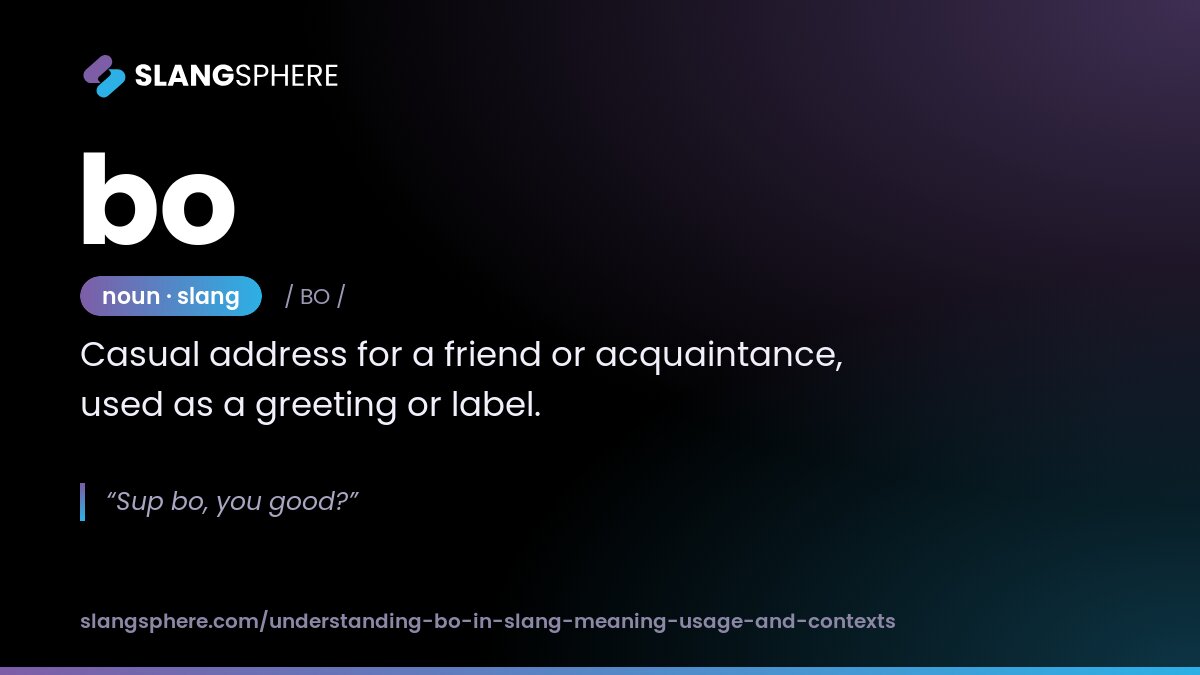
Main meaning: a familiar form of address for a friend, fellow, or man, used like “what up, bo” or “hey bo”. This use appears in spoken regional English and in hip-hop lyrics and broadcasts. ([ell.stackexchange.com](https://ell.stackexchange.com/questions/89949/bo-what-does-it-mean-exactly))
Secondary senses: the letters B.O. or b.o. are the common abbreviation for body odor in general English, unrelated to the greeting sense. Also historically bo has had other senses like an abbreviation of hobo or older colloquial uses, depending on era and region. ([dictionary.cambridge.org](https://dictionary.cambridge.org/us/dictionary/english/body-odor?utm_source=openai))
Where it comes from
The exact origin is not single-source clear. Historical dictionaries and slang references show multiple, long-running usages, and many linguists treat the greeting form as an apocopated form of “boy” or as a familiar address that circulated in U.S. speech for well over a century. Modern revivals in regional speech and hip-hop keep it alive. For a compact discussion see this Q&A and historical notes. Source on history and variants. ([ell.stackexchange.com](https://ell.stackexchange.com/questions/89949/bo-what-does-it-mean-exactly))
How people use it
- “What up, bo?”, standard greeting between friends; casual and friendly.
- “Ay bo, you good?”, checking on someone, same informal register.
- “Roll up, bo, we leavin’ in five”, addressed to a friend when coordinating plans.
- “Nah, bo, that move was wild”, used in reaction, still addressing a person directly.
- “Yo Bo, pass me that”, calling someone by a nickname or friendly address; can be used as a name substitute.
These examples represent how people actually use the form: short, direct, informal, usually among peers.
Tone and when not to use it
Tone: friendly, informal, often masculine-coded but used across genders. It signals familiarity and casual rapport rather than respect or formality. ([ell.stackexchange.com](https://ell.stackexchange.com/questions/89949/bo-what-does-it-mean-exactly))
When not to use it: avoid in professional emails, formal situations, or when you have not established rapport. Because usage is regional and social, using “bo” with strangers or in cross-cultural settings can sound too familiar or confusing.
Similar terms
yo, what up, bro, homie, boo, boi
FAQ
- What does bo mean on TikTok? On TikTok it is usually the same casual address or playful nickname, borrowed from spoken usage; context tells you if it is friendly or ironic. ([ell.stackexchange.com](https://ell.stackexchange.com/questions/89949/bo-what-does-it-mean-exactly))
- Is bo rude? Not by itself; it is informal. It only becomes rude if used sarcastically, aggressively, or by someone with no established familiarity.
- Is bo the same as B.O.? No. B.O. or b.o. is the abbreviation for body odor in standard English; that is unrelated to the greeting “bo”. See this dictionary entry for the abbreviation. Cambridge: B.O. (body odor). ([dictionary.cambridge.org](https://dictionary.cambridge.org/us/dictionary/english/body-odor?utm_source=openai))