Type D most often refers to the clinical “distressed” personality, a researched pattern of high negative emotion plus social inhibition; online it is also used as quick slang to tag someone as withdrawn, anxious, or emotionally gloomy. Context decides whether the speaker means the research term or casual shorthand.
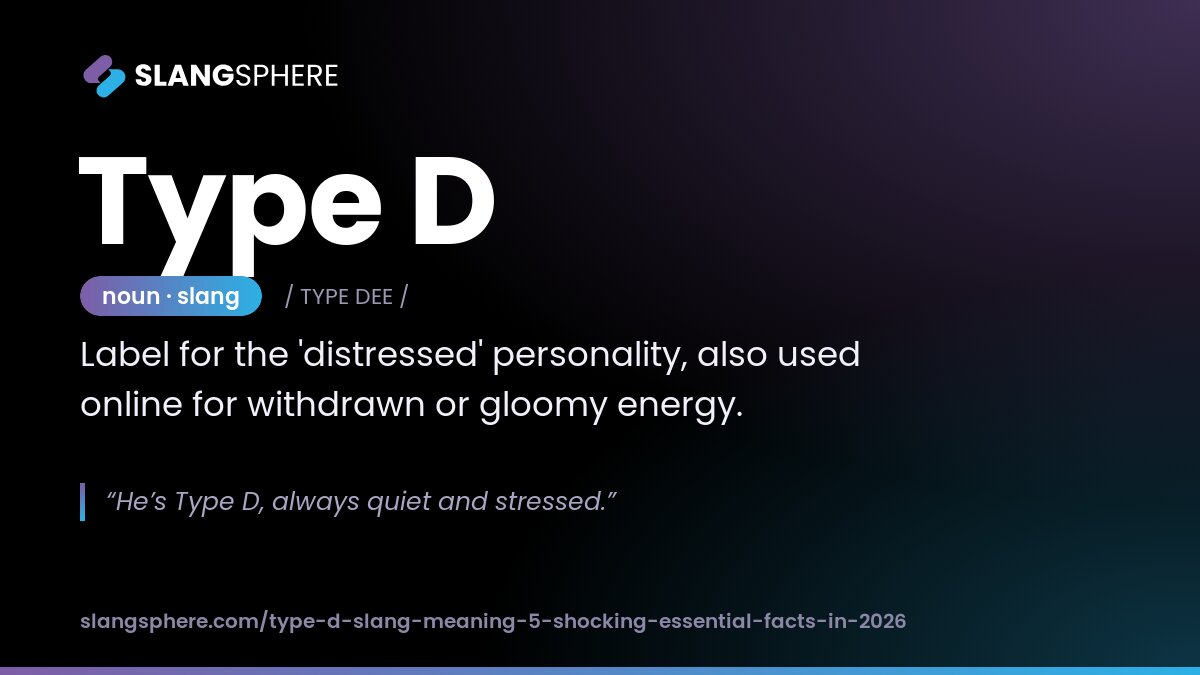
What it means
Main meaning: the term names a clinical research construct describing people who report frequent negative feelings and who hold back emotionally around others. That usage appears in medical and psychology literature and is treated as a measured personality pattern rather than a diagnosis.
Secondary, slang meaning: on social platforms people sometimes use the label as shorthand for a mood or archetype. In that sense it can mean anything from “emotionally closed off” to “melancholic energy,” depending on the community and the joke format. The slang use is informal and fuzzy, not a clinical assessment.
Where it comes from
The letterized Type system has roots in psychology research, where the specific distressed construct was developed and studied for links to health outcomes. See the American Psychological Association entry and a plain-language explainer for the research context: APA Dictionary entry, Psychology.com explainer. The online shorthand borrows the letter label and spreads through personality-meme formats and casual captions.
How people use it
- “My roommate is so Type D, always quiet but stressed”, tagging someone as inward and anxious.
- “Not my Type D”, a caption-style joke that compresses a whole dislike or mismatch into a short label.
- “That’s Type D energy”, describing a mood, often wistful or low-key gloomy, rather than a literal clinical trait.
- “Doc said I score high on negative affectivity, guess I’m Type D”, someone using the formal meaning after reading about the research.
- “Which type are you? A/B/C/D”, participation-meme format where letters are playful categories, not diagnoses.
Tone and when not to use it
The clinical label carries mental health and medical research baggage, so using the shorthand to mock someone’s emotions can be insensitive. Avoid applying the term to diagnose or shame people for anxiety or low mood. In workplaces and with vulnerable people, skip the joke and use clear, respectful language about behavior or feelings.
Similar terms
type a, type b, distressed, withdrawn, mood
FAQ
- What does Type D mean on social media?
Usually informal shorthand for a withdrawn, anxious, or gloomy vibe. It is context-dependent and not the same as a clinical evaluation.
- Is Type D the same as a diagnosis?
No. The research construct describes a pattern of negative affectivity and social inhibition, it is not a psychiatric diagnosis and should not be used to label someone clinically without proper assessment.
- Can calling someone that be offensive?
Yes, if used to mock or pathologize emotional states. Use care when joking about mental health or persistent distress.
Related Slang
- mood