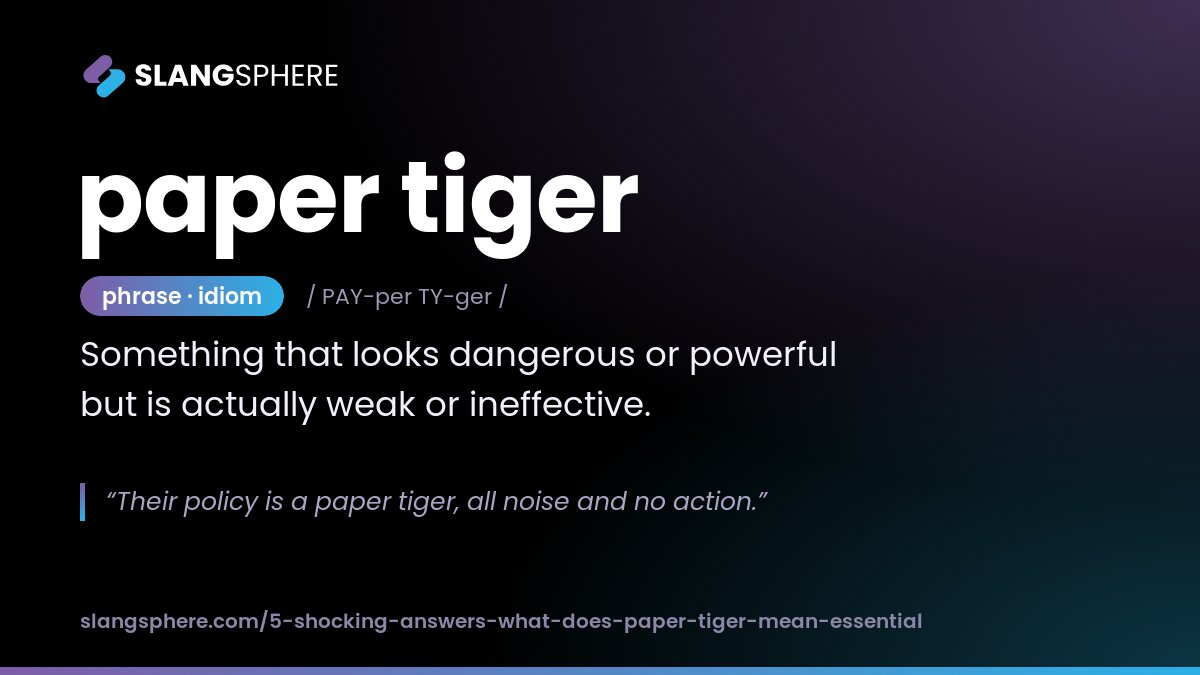
Paper tiger means something that looks powerful or scary but is actually weak, ineffective, or all talk. The image comes from a tiger made of paper: dramatic at a glance, useless up close. People use it for bluffs, fragile institutions, or threats with no real backing.
What it means
Main meaning: a person, group, policy, or threat that appears dangerous or strong but lacks actual power or effectiveness. The emphasis is on appearance versus reality: the danger is mostly show, not substance.
Secondary uses: a criticism of hollow institutions, laws with no enforcement, teams that hype themselves but lose, or a leader who mouths threats but cannot act. The phrase can be rhetorical, sarcastic, or political depending on context.
Where it comes from
The phrase is a direct calque of the Chinese idiom 紙老虎, zhǐlǎohǔ, literally paper tiger. The expression predates the 20th century in Chinese usage, and became widely known in English when Mao Zedong popularized it in his political writings and speeches. See Mao’s usage in his selected works and standard dictionary entries for the idiom. Mao, Selected Works, and the Cambridge dictionary entry for the English idiom Cambridge Dictionary.
How people use it
- “The security firm talks tough but never responds to breaches, total paper tiger.”, Calling out bluster without capability.
- “Their sanctions are a paper tiger, they won’t enforce them.”, Politically skeptical remark about weak follow-through.
- “Our rival’s pregame hype is hilarious, paper tiger energy.”, Sports trash talk about a team that underperforms.
- “That anti-bullying policy is a paper tiger if administrators ignore violations.”, Critique of rules without enforcement.
- “All that PR noise is a paper tiger; real change would need cash and staff.”, Pointing out performative gestures versus real action.
Tone and when not to use it
Tone: mostly dismissive, sometimes mocking, often political. It works in casual speech, journalism, and commentary. The phrase can sound contemptuous, so use it when you mean to downplay or delegitimize something.
When not to use: avoid in sensitive diplomatic, legal, or workplace settings where accusing an opponent of being weak could escalate tensions or seem unprofessional. It is not a slur, but it can be inflammatory in heated debates.
Similar terms
all bark no bite, empty threat, hollow threat, bluster, weak sauce
FAQ
What does paper tiger mean on social media? People use it the same way online: to mock accounts, policies, or trends that look intimidating but are ineffectual. It often appears in comments and snarky captions.
Is paper tiger offensive? Not inherently. It is a critical term, not a slur. It can feel insulting to be called one, so use it where blunt critique is appropriate and not needlessly personal.
Where did the phrase come from? It comes from the Chinese idiom 紙老虎, zhǐlǎohǔ, and was widely popularized in English through Mao Zedong’s political writings and translations.
Can I use it in formal writing? Yes, but sparingly. In formal analysis or journalism it signals a judgment that the subject lacks real power, so back the claim with evidence rather than only rhetoric.