

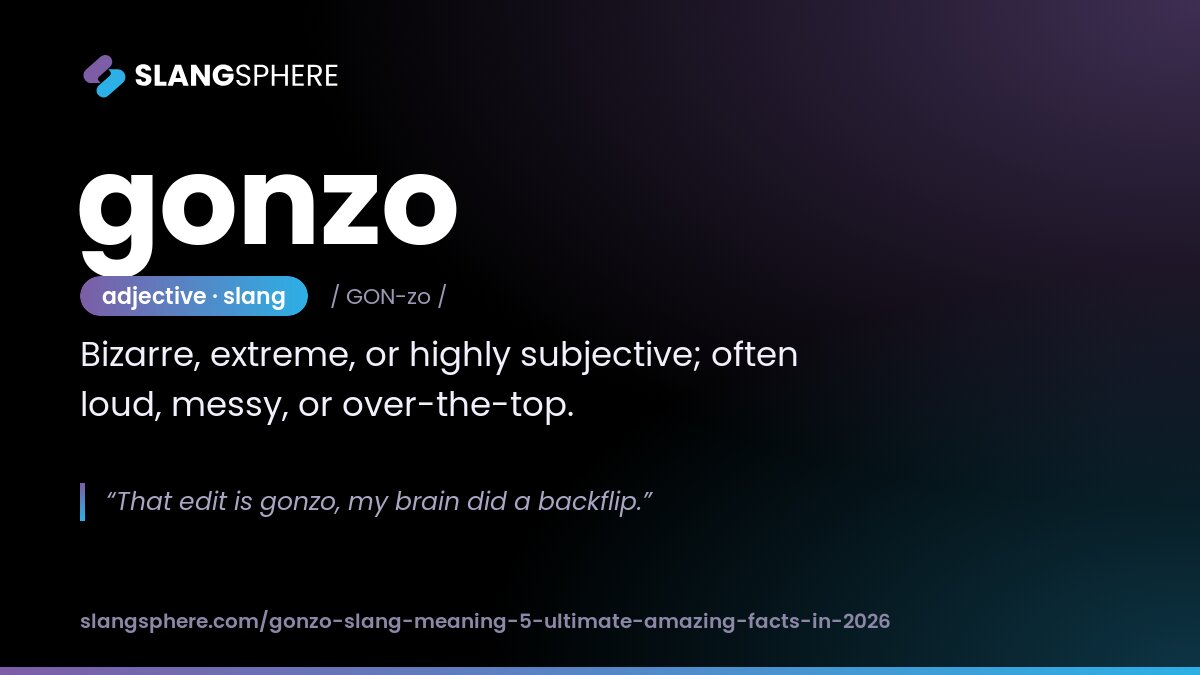
Gonzo means bizarre, extreme, or wildly subjective, usually describing a style, moment, or thing that feels chaotic and over-the-top. The sense comes from gonzo journalism but the word is now used casually to label anything that is frenzied, eccentric, or deliberately unpolished.
What it means
Main meaning: an adjective for something bizarre, extreme, or wildly subjective, often with a messy, high-energy vibe. Think loud aesthetics, off-kilter presentation, or reporting that puts the writer at center stage.
Secondary uses: a noun for a person who behaves eccentrically or recklessly, and historically a label for a style of journalism where the reporter is part of the story.
Where it comes from
The modern sense comes from gonzo journalism, a label applied in the early 1970s to Hunter S. Thompson’s subjective, hard-charging reporting. Journalist Bill Cardoso is credited with calling Thompson’s Kentucky Derby piece “gonzo,” and the term stuck as shorthand for that frenzied, first-person style. The deeper etymology is unclear, with linguists pointing to Italian gonzo for “foolish” or Spanish ganso for “goose” as possible roots.
For background, see Gonzo journalism on Wikipedia and an etymology overview at Etymonline.
How people use it
- “That festival set was totally gonzo, confetti and lasers everywhere,” a caption labeling an extreme, chaotic performance.
- “He wrote a gonzo piece about moving into the commune,” meaning deeply subjective, immersive reporting.
- “This edit is gonzo, my eyes do not know what to do,” used under a wild video or edit to praise its sensory overload.
- “She pulled up in that gonzo outfit, neon and clashing prints,” calling an outfit intentionally loud and over-the-top.
- “Don’t go gonzo on the spreadsheet,” jokingly warning someone not to be reckless or over-the-top with work.
Tone and when not to use it
Tone: casual, slightly slangy, approving or neutral when praising extravagance, mildly critical when implying reckless excess. It carries a playful toughness rather than polite critique.
When not to use it: avoid in formal writing, neutral professional communications, or when clarity matters. It is not inherently offensive, but using it to describe a person can sound dismissive. Do not use it for sensitive topics where “extreme” could minimize harm.
Similar terms
extra, wild, chaotic, trippy, over-the-top, messy
FAQ
- What does gonzo mean on social media? On social platforms it usually flags something loud, eccentric, or visually intense, often as a compliment for boldness.
- Is gonzo the same as gonzo journalism? Related but different: gonzo journalism is the original specific style of subjective reporting; calling something “gonzo” borrows that attitude and applies it more broadly.
- Is gonzo rude? Not inherently. It can be playful or critical depending on tone, but calling a person gonzo can read as dismissive, so use with caution.
- Can you use gonzo at work? Generally no, unless your workplace is informal and the context is about creative work or humor.
Related Slang
- extra
- messy
