

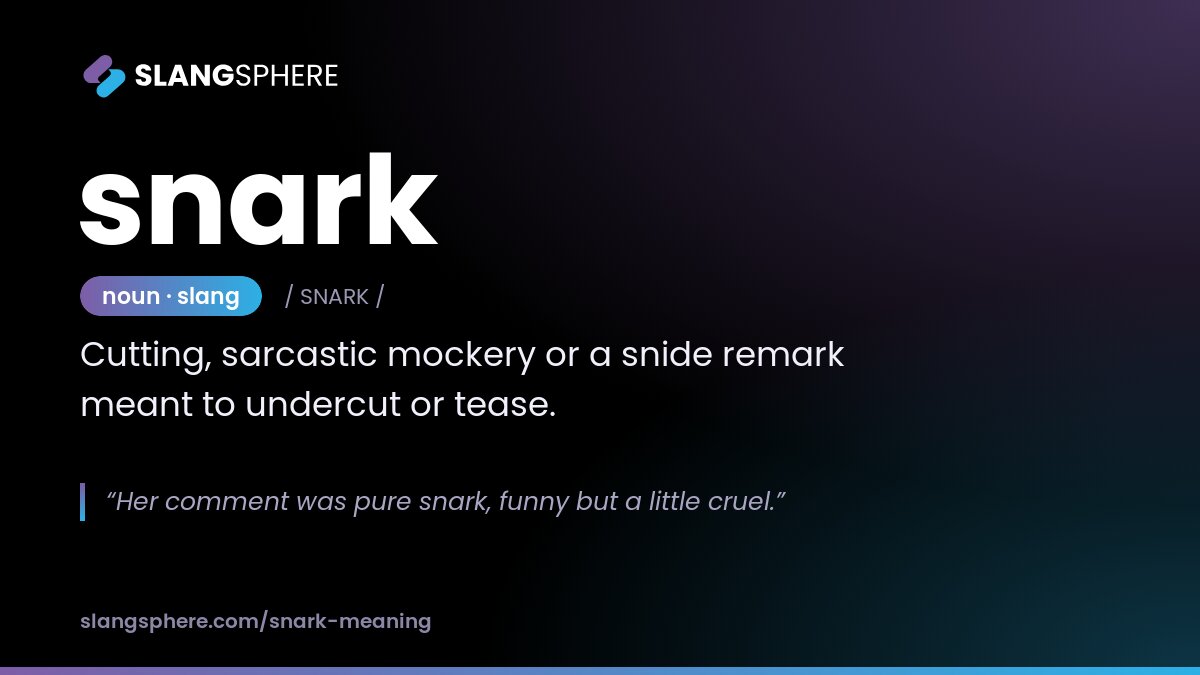
Snark means a cutting, often witty mix of sarcasm and snide mockery used to undercut, tease, or dismiss someone. It usually lands between playful teasing and outright insult, and can be delivered as a single remark, a review tone, or ongoing commentary.
What it means
Main meaning: snark is snide, sarcastic mockery, a remark or attitude that expresses contempt under the cover of humor. It is often deliberately barbed, aiming to expose or embarrass the target while entertaining an audience.
Secondary meanings: people also use snark as shorthand for a snarky tone or persona, or for communities that practice this kind of commentary, especially online.
Where it comes from
The modern noun snark appears to be a back-formation from the adjective snarky, which dictionaries trace to the early 20th century and to senses of “snort” or “snide.” Exact origin is unclear, but lexicographers note it developed from longstanding English words for snorting or sneering. For usages and dictionary definitions see Merriam-Webster and academic discussions of online snark as a social practice at MIT CMSW.
How people use it
- “Her review was pure snark: five paragraphs of jokes that barely hid the insult.”, describes a review written with mocking humor rather than straight critique.
- “Don’t feed the snark in the comments, it just escalates.”, warning about users posting barbed jokes that provoke replies.
- “He’s playing snark for likes, not actually making a point.”, dismissing performative mocking meant to get engagement.
- “Posting receipts and snark about influencers is their whole vibe.”, refers to online communities that chronicle and mock public figures.
- “That comeback was peak snark, had me laughing and wince-ing.”, praising a remark as cleverly cutting.
Tone and when not to use it
Snark often reads as humorous to those who share the joke, and hostile to those targeted. It can be playful among friends, but becomes mean or humiliating when used against people in vulnerable positions. It is generally inappropriate in formal workplaces, serious reporting, or conflict-resolution settings.
On social media, snark can blur into harassment when it focuses on personal attacks, doxxing, or coordinated piling-on. If your goal is clarity, reconciliation, or professional critique, avoid snark and choose plain, direct language instead.
Similar terms
snarky, shade, roast, drag, sass, sarcasm
FAQ
What does snark mean on TikTok? On TikTok snark usually means posting or commenting with a mocking, sarcastic tone about creators or trends. It can be a single quip or an entire account devoted to that voice.
Is snark rude? It can be. Snark is often funny, but it can cross into rudeness or cruelty depending on intent and context. Audience and power dynamics matter a lot.
How is snark different from sarcasm? Sarcasm is broader, a tone that says the opposite of what is meant. Snark specifically carries a snide, mocking edge and is usually aimed to undercut or belittle.
Can snark be constructive? Sometimes. Light snark can signal disagreement without a long argument, but constructive feedback is clearer when you drop the snark and explain specifics.
