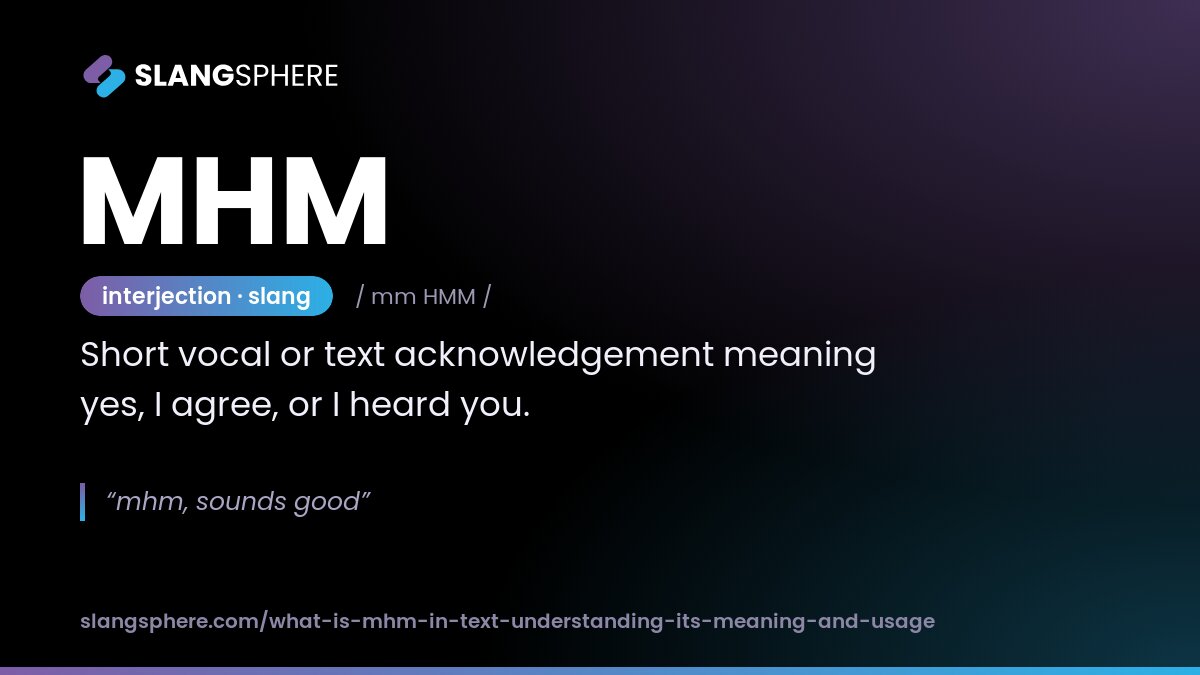
Mhm, written mhm, is a short spoken and written acknowledgement that usually means yes, I agree, or I heard you. It functions as a minimal response in conversation and texting, letting the other person know you are following along; tone and punctuation decide whether it feels warm, neutral, or dismissive.
What it means
Main meaning: a brief affirmative or acknowledgement. People use mhm to mean yes, I agree, I heard you, or okay. It is the written cousin of the vocal mm-hmm or uh-huh and carries the same basic signal: the speaker is listening and accepts what was said.
Secondary meanings: because mhm is so short, context and delivery change the sense. A quick, friendly mhm can encourage someone to continue. A flat or delayed mhm can signal boredom, impatience, or mild annoyance. Drawn-out or punctuated mhm can read as sarcasm.
Where it comes from
The form comes from spoken minimal responses like mm-hmm and uh-huh that linguists identify as backchannels, cues listeners use to show attention and agreement. Linguistic research on minimal responses shows the same short sounds serve multiple conversational functions depending on timing and intonation. For a usage overview see Dictionary.com and for a linguistic treatment of hm-type responses see the phonetics literature.
Dictionary.com entry on mhm, and a classic paper on hm/mm responses in speech science provide useful background.
How people use it
- Text: “Did you get the tickets?” “mhm”, quick confirmation, yes I got them.
- Chat: “I think we should leave at 7.” “mhm, good idea”, agreement plus continuation.
- Comment: “That was wild” “mhm”, acknowledging the statement, possibly neutral.
- Reply to thanks: “Thanks for the ride” “mhm”, casual you-rewelcome or no problem.
- During a story: “So then he said, ” “mhm”, listener cue, please continue.
- Sarcastic use: “You never call me back” “mhm” (flat), dismissive or passive-aggressive.
Tone and when not to use it
Tone matters more for mhm than for longer replies. In face-to-face talk, pitch, length, and facial expression disambiguate it. In text, punctuation, emoji, or follow-up words do that job. Use a fuller reply if you need to show warmth, gratitude, or seriousness. Avoid mhm when someone is sharing something vulnerable, or when politeness and clarity are required, such as job communications, formal requests, or first-time introductions.
Similar terms
- mmhmm
- uh-huh
- yeah
- okay
- sure
FAQ
- What does mhm mean on TikTok? On TikTok it works the same as elsewhere: a short yes or acknowledgement. Creators may use it in captions or comments to signal agreement or a knowing reaction.
- Is mhm rude? Not inherently. It becomes rude if used to shut someone down, paired with sarcasm, or sent where a fuller, polite response is expected.
- Is mhm the same as mmhmm? They are close. Both are minimal affirmative responses; mhm is a compact written form, while mmhmm often mimics the drawn-out vocalization and can feel stronger or more emphatic.
- How can I tell if it means yes or sarcasm? Look at context, punctuation, reply speed, and any emojis. A cheerful emoji or extra words means friendly agreement; a delayed single-dot reply or nothing else can be flat or dismissive.
Related Slang
- yeah